Showing posts sorted by date for query focus on solution. Sort by relevance Show all posts

Sunday, December 14, 2014

The Anger Wheel of Choice: Anger is Just a Feeling

When I was growing up, I didn’t know that anger is just a feeling. To me anger meant withdrawal of love. My mother didn’t tell me she was angry. She just wouldn’t speak to me for days.  However, she did “speak” loud and clear with the look of disgust and disapproval on her face whenever she looked at me during those days of silence . My childlike mind twisted that to mean that people would stop loving me if I got angry.

Lynn Lott, co-author of several of the Positive Discipline books, and my dear friend and mentor, taught me that feelings are always okay. What we do about those feelings may not be okay. In other words, feeling angry is okay. Withdrawing love, or the many ways I expressed my anger, is not okay, (more about that later).

Knowing that anger is just a feeling, is always okay and may help change some old childhood beliefs. Recently I was feeling angry with a friend. Instead of following my previous pattern of trying to talk myself out of my anger, or making snide remarks, I said to my friend, "I want to tell you how angry I am, and I want you to still love me." I did and she did. When I took responsibility for my anger, instead of dancing around it, my friend was able to share her point of view. Then we apologized for our misperceptions and felt great again.

Many adults have not learned the valuable language of feelings. We are afraid that if we feel something we have to do something hurtful to others or ourselves. This is usually based on past experiences.

The Anger Wheel of Choice can help our children learn another way. During a calm time you can teach them that what they feel is always okay, and that what they do is not okay if the “doing” hurts others or themselves. You can show them the wheel of choice and teach them these alternative ways of expressing their anger that does not hurt others.

You might want to combine the Anger Wheel of Choice with the Positive Time-Out tool card, the Understanding the Brain tool card and the Focus on Solutions tool card. Let your children know that once they have expressed their feelings and calmed down, they might be able to think of more respectful ways to express their anger to another person, such as simply saying, “I’m angry at you right now. When we both feel better I hope we can find a solution that is respectful to both of us.”

It is just possible, that if children learn these life skills, they would feel more capable and confident, would experience more loving relationships with others, and would be instruments of peace in the world.

Monday, September 15, 2014

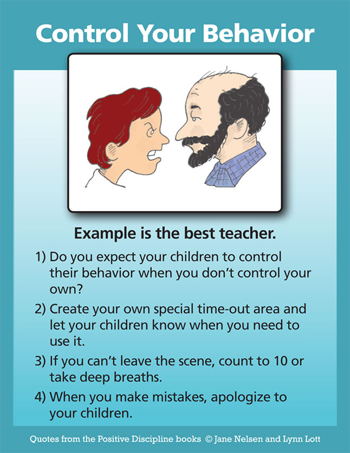
Control Your Behavior


The Positive Discipline Tool Card  of "Control Your Behavior" is sometimes easier said than done. Have you ever lost control of your behavior with your children? Listen to the following audio excerpt from Building Self-Esteem Through Positive Discipline as I discuss a time when I completely lost control with my daughter. (Click Here if you cannot see the audio player.)

Fortunately we can use the parenting tool of "Mistakes" to recover when we lose control of our behavior. But it is always better if we can find ways to avoid losing control in the first place. The suggestions listed on the tool card are:

1. Create your own special time-out area and let your children know when you need to use it.

Some parents are uncomfortable with this solution, especially when dealing with younger children. But if your children are older and you can set up this system in advance, it can be quite effective. It is nearly impossible to solve problems at the time of conflict when both the child and the parent have flipped their lid. The result is distance and hurt feelings. Usually followed by guilt!

Why not let your children know that you are taking a time out. Remove yourself from the situation and get centered before attempting to solve the problem. How you take your time-out is up to you. Maybe you will go to your room. Maybe you will go for a walk. Maybe call a close friend and discuss the problem. Whatever you decide, the important thing is to take time to cool off before addressing the problem.

2. If you can't leave the scene, count to 10 or take deep breaths.

This is a good solution if you have younger children or the situation requires your presence. It is also okay to share what you are feeling. "I'm so angry right now, I need to calm down before we talk." Kids need to know that what they feel is always okay, but what they do is not always okay. You model this by sharing your feelings without reacting to them and without blaming your children for your feelings. Avoid saying, "You make me so angry."

3. When you make mistakes, apologize to your children.

As you heard in the podcast above, I eventually calmed down and apologized to my daughter. Children are wonderfully forgiving when we take time to sincerely apologize when we lose control. During lectures I ask, "How many have you have apologized to a child?" Every hand goes up. I then ask, "What do they say?" The Universal response from children when parents apologize is, "That's okay."

By apologizing, you have created a connection (closeness and trust). In this atmosphere you can work together for a solution. Once again you have demonstrated that mistakes are opportunities to learn and that you can then focus on solutions.


Monday, July 21, 2014

Control or Cooperation


Are you trying to gain control over children or with children? Trying to gain control over children is hard. It takes constant effort. You have to be very vigilant to police the action of children so you can implement your control tactics—usually punishment and rewards. You have to catch children being “good” so you can reward them and catch them being “bad” so you can mete out the punishment. It never ends—and what happens when you are not around? If you are very good at being in control over children what have they learned? Have they learned self-discipline, respect for self and others, responsibility, problem-solving skills, cooperation?

Trying to gain control over children is disrespectful and greatly decreases your chances of winning cooperation. Disrespectful methods invite distance and hostility, rebellion, revenge, sneakiness to avoid getting caught, or, worst of all, a child’s developing belief that, “I am a bad person.” On the other hand, respectful methods invite closeness, trust, and cooperation.

Winning Cooperation

Rudolf Dreikurs taught the importance of “winning children over”, instead of “winning over children.” One of my favorite terms is “connection before correction.” The best way to make a connection and win children over is to be respectful. One of the best ways to be respectful is to “get into the child’s world” and express understanding of the child’s feelings. Showing empathy is not the same as condoning. A really nice touch is sharing a time when you might have felt the same. These are the steps to create the connection to increase the chances that you can work for correction because children are likely to listen to you AFTER they feel listened to.

Correction Does Not Involve Punishment

In can be so difficult for parents and teachers to think they are not doing their job if they don’t engage in a lecture or some kind of consequence (usually a poorly disguised punishment). This will take you right back to the consequences (resistance and/or rebellion) you will experience by trying to gain control over instead of with your children. What do children learn when they are respectfully involved in finding a solution that works for everyone? Thinking skills, problem-solving skills, respect for self-and others, self-discipline, responsibility, listing skills, motivation for following the solution they have helped create. The list could go on and on. And, what better way to achieve control with, and to win cooperation. Once you have achieved a connection you have created an atmosphere where you can focus on a solution together. You have won cooperation.

Monday, July 14, 2014

Don’t Back Talk Back


Mrs. Henderson told her son, Jon, for the third time that evening, “You had better do your homework before it gets too late.

Jon shot back, “If it is so important to you, why don’t you do it!”

Mrs. Henderson was shocked. After all, she was only trying to help. She reacted by saying, “Don’t talk to me that way, young man. I’m your mother.”

Jon reacted right back, “Well, don’t talk to me that way. I’m your son.”

At this point Mrs. Henderson stepped in and shouted; “Go to your room right now. You are grounded until you can learn to be respectful.”

Jon shouted back, “Fine,” as he stomped off to his room and slammed the door.

What creates a scene like this? Was Mom modeling respect as she shouted at her son to be respectful? No. Was Jon being disrespectful to his mother? Yes. Was Mom being disrespectful to Jon? Yes. Let me count the ways.
  1. She nagged.
  2. She took control and gave orders (no matter how pleasantly).
  3. She robbed Jon of learning responsibility by taking over the responsibility of his homework.
  4. She didn’t invite Jon to figure out what he wanted and how to get it.
  5. She is not willing to allow him to experience the consequences of his choices—and to learn from them.
Why is it that parents think it is their job to see that homework gets done? Oh, I can hear your objections already: “We can’t just let him fail.” Of course parents don’t want their children to fail. All the more reason to teach children self-discipline, self-control, goal setting, and problem-solving skills instead of trying to control them. All the more reason to communicate WITH children instead of TO them, FOR them, or AT them. How to accomplish respectful communication and help children develop a sense of capability and self-discipline is the focus of Positive Discipline.

For now let's discuss “backtalk” and how to stop “back talking back.” The following suggestions are from the book Positive Discipline A-Z by Jane Nelsen, Lynn Lott, and H. Stephen Glenn.

Suggestions
  1. In a calm, respectful voice, tell your child, “If I have ever spoken to you that way, I apologize. I don’t want to hurt you or be hurt by you. Can we start over?”
  2. Count to ten or take some other form of positive time-out so you don’t “backtalk” in reaction. Avoid comebacks such as, “You can’t talk to me that way young lady.”
  3. Use the “back talk” as information (it could tell you that something is amiss) and deal with it after you have both calmed down. Look for places you have been turning issues into power struggles with your child.  
  4. Instead of focusing on the disrespect, focus on the feelings. Say something like, “You are obviously very upset right now. I know it upsets me when you talk that way. Let’s both take some time out to calm down. We can talk later when we feel better. I’d like to hear what you are upset about.
  5. Do not use punishment to “get control.” When you have both calmed down you can work on a respectful solution that works for both of you..
  6. Share your feelings, “I feel very hurt when you talk to me that way. Later I want to talk to you about another way you could tell me what you want or how you feel.”  Or you could say, “Whoa, I wonder if I did something to hurt your feelings, because that certainly hurt mine.”
  7. If you are not too upset, try hugging your child. Sometimes children are not ready to accept a hug at this time. Other times a hug changes the atmosphere for both of you to one of love and respect.
Planning Ahead to Prevent Future Problems
  1. Be willing to take a look at how you might be teaching the very thing you abhor in your child by being disrespectful to her. Have you created an atmosphere of power struggles by being too controlling or too permissive? 
  2. Make sure you do not “set your child up” by making disrespectful demands. Instead of giving orders, create routines together during family meetings.
  3. Instead of saying, “Pick up your shoes,” ask, “What about your shoes?” You will be surprised how much more inviting it is to ask than to tell.
  4. Once you have both calmed down, let her know you love her and would like to work on a respectful solution to what happened. Take responsibility for your part and work on a solution together.
  5. Apologize if you have been disrespectful. “I can see that I was disrespectful when I demanded that you pick up your shoes. How can I ask you to be respectful when I’m not?” Let her know that you can’t “make” her be respectful, but that you will work on being respectful yourself.
  6. Have regular family meetings so family members learn respectful ways of communicating and focusing on solutions.

Life Skills Children can Learn

Children can learn that their parents are willing to take responsibility for their part in an interaction. They can learn that back talk isn’t effective, but that they will have another chance to work on respectful communication.


Monday, May 5, 2014

FOCUS ON SOLUTIONS


Many parents and teachers have reported that power struggles are greatly reduced when they focus on solutions. Focusing on solutions creates a very different family and classroom. Your thinking and behavior will change, and so will the thinking and behavior of your children.

The theme for focusing on solutions is: What is the problem and what is the solution? Children are excellent problem solvers and have many creative ideas for helpful solutions when adults provide opportunities for them to use their problem-solving skills.

The Three Rs and an H for Focusing on Solutions are the same as the Three Rs and an H of Logical Consequences. In fact, the first 3 are identical. They are presented again here to help change the tendency toward the use of Logical Consequences in favor of Focusing on solutions.

The Three Rs and an H for Focusing on Solutions:

1. Related

2. Respectful
3. Reasonable
4. Helpful

The following is an excerpt from the book Positive Discipline in the Classroom that illustrates the amazing difference in brainstormed suggestions when students first focus on logical consequences and then focus on solutions:

During a class meeting, students in a fifth-grade class were asked to brainstorm logical consequences for two students who didn’t hear the recess bell and were late for class.

Following is their list of consequences:

1. Make them write their names on the board.
2. Make them stay after school the same number of minutes they were late.
3. Take away from tomorrow’s recess the same number of minutes they were late today.
4. Take away all of tomorrow’s recess.
5. Yell at them.

The students were then asked to forget about consequences and brainstorm for solutions that would help the late students get to class on time.

Following is their list of solutions:

1. Everyone could yell together, "Bell!"

2. The students could play closer to the bell.

3. The students could watch others to see when they are going in.

4. Adjust the bell so it is louder.

5. The students could choose a buddy to remind them that it is time to come in.
6. Someone could tap the students on the shoulder when the bell rings.

The difference between these two lists is profound. The first looks and sounds like punishment. It focuses on the past and on making children pay for their mistakes. The second list looks and sounds like solutions that focus on helping the students do better in the future. The focus is on seeing problems as opportunities for learning. In other words, the first list is designed to hurt; the second is designed to help.

Monday, March 11, 2013

Applying the Positive Discipline Principles

Last year we introduced 52 Positive Discipline Tools in 52 Weeks. All of these Positive Discipline tools are amazing! But it can be overwhelming to try and apply them all at once. So this year we will share success stories that will inspire you as you read how others have applied the Positive Discipline principles. It is always comforting to know that others share the same struggles and read how they found solutions.

We would also love to hear your own success stories. You can email them to contact@positivediscipline.com or join our success stories group on our private social network.

Family Meetings - The 22-Minute Discipline Solution

Our first success story was printed in Parents Magazine. Dr. Jane Nelsen was interviewed by Francesca Castagnoli and she wrote an article titled The 22-Minute Discipline Solution. Read how Francesca has created a tradition of weekly family meetings and how her children look forward to what they call "Funday". Click Here to read the full article.

This coming week we will be posting another success story featuring the Positive Discipline Tool of Connection Before Correction. Stay Tuned!

Below are some more resources that will help you apply the Positive Discipline Tools:

Find a Local Parenting Class

Attending a parenting class is a great way to help you implement the Positive Discipline tools. Having a group of like minded parents with the same goals and same problems will help you focus. Click Here for a list of local parenting classes.

Take our Online Parenting Class

If you can't find a local parenting class, consider signing up for our Online Parenting Class. Our online class is the next best thing to being there in person. You get to participate vicariously as Dr. Jane Nelsen and her daughter Mary Nelsen Tamborski lead your through a six week parenting class. Watch the preview below.

Click Here to sign up for the online class.


Join Our Private Social Network

Our free Positive Discipline Network is a friendly, encouraging Positive Discipline community. Questions are answered by members and Certified Positive Discipline Associates. You can join special interest groups, and you can do a search of topic that has already been covered to find support, encouragement, and ideas from other parents who are experience similar challenges. Click Here to sign up.

Get The Positive Discipline Tool Cards

The Positive Discipline Tool Cards are a great way to have all the tools right at your fingertips. They are available as a Deck of Cards as well as an App for Android and Apple devices.


Wednesday, January 9, 2013

THE ART OF ACTIVE LISTENING

Active (or reflective) listening is another effective tool of communication, one that will serve you well as you parent your child and (sooner than you may think) the adolescent that child will become. Active listening is the art of observing and listening to feelings, then reflecting them back. Active listening does not require that you agree with your child’s feelings, but it allows your child to feel connected and understood— something all people need—and provides an opportunity to explore and clarify those mysterious impulses known as emotions.

Four‐year‐old Chrissy ran through the front door, slamming it so forcefully that the pictures rattled on the wall, and promptly burst into tears. “Tammy took my ball,” she wailed. “I hate her!” Then Chrissy threw herself onto the sofa in a storm of sobs.

Her mom, Diane, looked up from the bills she was paying. Resisting the impulse to scold Chrissy for slamming the door, she said quietly, “You seem pretty angry, kiddo.”

Chrissy pondered for a moment. “Mom,” she said plaintively, sniffling a little, “Tammy is bigger than me. It isn’t fair for her to take away my stuff.”

″It must be pretty frustrating to be picked on by a big girl,” Diane said, still focusing on reflecting her daughter’s feelings. “Yeah. I’m mad,” the little girl said firmly. “I don’t want to play with her anymore.” She sat quietly for a moment, watching as Diane put stamps on envelopes. “Mom, can I go play out in the backyard?” Diane gave her daughter a hug—and a great deal more.

By simply reflecting back her daughter’s underlying feelings (active listening), Diane refrained from lecturing, rescuing, or discounting her daughter’s feelings. She allowed Chrissy the opportunity to explore what was going on for her, and in the process, Chrissy discovered a solution to her own problem. Some other time, Diane might be able to talk with Chrissy about avoiding future problems—and perhaps ask her what she could do to express her anger instead of slam the door.

Diane also showed respect for her daughter’s feelings. Parents often do not agree with (or completely understand) their children’s emotions, but active listening does not require you to agree or completely understand. It invites children to feel heard and lets them know it’s okay to feel whatever they feel. Validating a child’s feelings with love and understanding opens the door for real connection and problem solving and works toward building a lifelong relationship of love and trust.

Pretend these statements are made by a child. How would you respond?

″No! I won’t take a nap!”
″I want a bottle like the baby has.”
″I hate going to the doctor.”
″Nobody will let me play with them.”

Some parents try to argue a child out of her feelings in hopes of changing her mind or helping her feel better. These attempts may sound like this:

″Of course you need your nap—you’ve been up since six. When will you learn that you need to rest?”
″Don’t be silly. Only babies use bottles. You’re a big boy now.”
″I keep telling you, you have to go to the doctor to feel better.”
″Why sweetie, you know you have lots of friends. What about . . .”

Each of these examples may leave the child feeling misunderstood and defensive—with the likely result of an argument and frustration for both of you. Active listening might sound like this:

″You look disappointed that you have to stop playing with your toys. You were having a lot of fun.”
″Sounds like you’re feeling left out in all the fuss over your new baby sister. Is there more you can tell me?”
″Sometimes I feel a little afraid of going to the doctor, too.”
″You seem pretty sad about being ignored by the older kids.”

These responses make no judgments and open the door for children to go further in exploring their feelings. Asking “Is there more?” indicates a willingness to listen and may help a child discover deeper, buried feelings.

Like most adults, sometimes all children really need is for someone to listen and understand. Active listening will help your child learn about his own feelings (and appropriate ways to express them) and will help you focus on what’s really important.

Sunday, January 8, 2012

Encouragement

Many of you know that we have a Positive Discipline Social Network where members encourage and support each other in the practical application of Positive Discipline. Recently someone posted a discussion about a friend who is feeling discouraged about a son who keeps getting into trouble at a school that uses the colored card system. Every time he “misbehaves,” he gets a colored card and his parents are expected to punish him at home.

I had to respond to this discussion because I have a close friend who is going through the same thing. Of course you might guess my opinion of the color cards—a very dysfunctional system. Then teachers encourage parents to be dysfunctional at home—adding more punishment. Before I continue, I will say that there are many good things at my friend’s child’s school—including the teacher. The school and this teacher simply believe in Behaviorism—that punishment and rewards are the best way to motivate “good” behavior—very different from the Adlerian Psychology base of Positive Discipline. So, I will share with you the advice I have given to my friend.

Don't add punishment at home. Keep encouraging him to focus on solutions. My friends concern was that his solution was to be sent to his room for 5 minutes and she didn't think that was severe enough.

At this point I have to digress and editorialize. It is so interesting to me that parents and teachers are willing to keep doing a punishment over and over, even if it doesn't work, but stop doing a Positive Discipline tool after one or two tries because it doesn't seem to work--right away.

I told my friend to take his suggestion and send him to his room for 5 minutes (very different from punishment when it is his idea). When he comes out avoid discouraging lectures. Use encouragement.  Just say, "I hope this works." If it doesn't work—which it won't because he is only a kindergartner and gets colored cards for things like talking (socializing with his friends)—which is developmentally appropriate for a Kindergarten child to do. (Arrrgggghhh!).

Celebrate every time he gets a colored card. This provides another opportunity for him to practice working on solutions. Every time he does, be encouraging and simply say, "Cool. I hope this works."  No reprimands when it doesn't—just anther opportunity to practice problem solving—over and over and over.

Now lets time travel five years from now. Make some guesses about what a child might be thinking, feeling, and deciding about himself after many opportunities and encouragement to experiment with solutions when he gets into trouble. Then make some guesses about what that same child might be thinking, feeling, and deciding after experiencing punishment at school and at home every time he gets into trouble.

It is very important to consider the long-term results of what we do. Lately I have been using the analogy of what it takes for a child to learn to talk—years of example—first to say a word, then more listening to examples and encouragement to learn sentences, and more years to keep developing and perfecting language. Why do we expect immediate results for other kinds of learning. Why do we expect social (behavior) learning to be immediate? And, how well would children learn to talk if they were humiliated and punished every time they got it wrong.

Children learn what they live. If we want our children to grow up learning to be kind and firm and respectful, we better make sure that is what they live. Remember that encouragement is the foundation of Positive Discipline. As Rudolf Dreikurs said, over and over, "A child needs encouragement like a plant needs water. It is essential to healthy growth and development.

Listen to the excerpt below which beautiful illustrates how encouragement can work much better than punishment. The following is an excerpt from the Building Self-Esteem Through Positive Discipline MP3.

The Discouraged Child

Sunday, January 31, 2010

Put Them in the Same Boat: A Positive Discipline Tool Card


Put Them in the Same Boat

My son Brad Ainge is choosing a tool card a week from the deck of Positive Discipline Tool Cards and sharing his efforts to follow the advice on each card in his blog: http://www.singledadbrad.com/  I’ve been raving about his blog and telling everyone to read it because he is such a good writer—funny and heartwarmingly real.
I’ve decide to do a blog on his blog, either sharing articles I have written on the tool card he chooses, or responding directly to his musings, or both.  I have picked a touchy one to start with—one on which, as Brad shares, we disagree. He’ll soon discover that we really don’t.                                                                         You might want to read Brad’s blog first on “Put Them in the Same Boat” to make sense of mine.
After reading Brad’s blog, I realize we don’t really disagree.  Staying out of fights is not the same as “not being around” when the fights take place. Actually, parents should not stay out of fights until they have taught their children problem-solving skills through family meetings and other one-on-one problem solving sessions.

Focus on Solutions

            My favorite way to “put kids in the same boat” is to guide them to focus on solutions.
"What ideas do you kids have to solve this problem?"
                    "Which one of you would like to put this on our family meeting agenda."
                    "I have faith in you two to work this out."  (Of course, you have been teaching them lots of problem-solving skills.)
                    "Pig pile!" as you jump on both of them and wrestle them to the ground."
                    "Would it help you both to go to your 'positive time-out' spaces until you can access your rational brains to work on a solution." (Of course, you have taught them about the brain, and how they go into their 'fight/flight response' when they are upset, and taking time to calm down allows them to access their rational brains again--and that is why it is so helpful to have a positive time-out area that helps them feel better.)
                    None of these suggestions involve neglect or punishment, and it isn’t really staying out of children’s fights. It is getting involved in a way that let’s them know you love them both, and you guide them toward finding solutions.

Belonging and Significance

            Most fighting involves issues of "belonging and significance.” From a kid’s point of view, it is difficult to understand that parents have more than enough love to go around. They think they have to compete for the love. So, they do what politicians do—put the other party down so they can look better. Adler or Dreikurs called it "deflating to inflate"--try to make yourself look good by making someone else look bad. Or, one child might “provoke” another child. The parent doesn’t see this. All he sees is the provoker clobbering the provokee. So the parent gets on the case of the provoker, not realizing that he has just reinforced the idea the provoker has that the way to be special is to get the provokee in trouble.
      The way parents interfere in fights, often increases the competition. When they take one child's side, they reinforce the idea that parents can love only one child at a time—so the competition increases. This is why we suggest that you "put children in the same boat" and treat them the same. By the same, we mean don't take sides. You don't really know who started it anyway. You don't see the subtle things one child might do to provoke another child into "reacting." So, put them in the same boat to "focus on solutions."
            If they up the ante—trying to get the same response they are used to—it may be best to walk away saying, “I have faith in you to solve this problem,” or “both of you go to your corners until you feel better so you can do better.” If you are afraid there will be violence when they are left together, put them in the same boat by saying, “Kids, you’ll need to separate until you are ready to find a solution. Eventually they might learn that cooperation is a better way to find belonging and significance than competition.


Monday, October 20, 2008

Defiance: Where does it come from?

Question:

Dear Jane:

My daughter is 7 3/4. This morning, she left the house and walked to school without saying a word. What is an appropriate disciplinary action for this? I feel that the issues are:

1) Anxiety: in me & her Kindergarten Brother - every morning we walk to school as a family, she snuck out the back door and headed to school. Meanwhile, my son and I were calling around the house, and looking around our property for her. We walked to school hoping that she would be there. My son was worried that Madison would be afraid if we're at school and she was still home. I knew she would be there, but in the back of my mind I did have worry about her safety.

2) Defiance: I believe part of her sneaking out without saying anything was an act of defiance. Earlier she had hit her brother and taken his Pokemon cards away. I had previously told her not to touch his cards while they were getting ready for school - we have a rule about no playing with toys while getting ready or they get taken away and put in my room. After the incident I asked her to give me her Pokemon cards - which she said were lost. I then asked her to think about what else of hers I could hold on to until she figures out how to stop hitting her brother and playing with cards while getting ready.

I was thinking that one angle might be to talk to her about what it means to be in the family, including the privileges; pack up some of her "things", and give her the opportunity to act like a part of the family and earn her things back.

Looking forward to your insight. Jill

Answer:

Hi Jill,

A new theme of Positive Discipline is "Connection before Correction." The first thing you need to do is make a connection with your daughter. There are several ways to do this.
  1. Make sure the message of love gets through: Honey, I really love you and I need your help to figure out how to solve this problem.
  2. Validate her feelings: Sweetie, I'm wondering if you are feeling angry about what happened this morning? I wonder if it hurt your feelings when I yelled at you and you wanted to hurt me back by leaving without telling me.
  3. Name what is going on and take responsibility for your part: I think we are in a power struggle or a revenge cycle and I'm wondering what I have done to create this. Maybe I'm being too bossy and focusing on punishment instead of having faith in you to work out solutions.
  4. Try a hug.

Okay, you may be wondering, after the connection--then what? After a connection has been made, children (and adults) exit their mid brain mentality (fight or flight) and enter their rational minds where positive learning can take place. During this time you can focus on a solution instead of a punishment (even if it is called appropriate disciplinary action): Honey, I really would like to hear your version of what happened this morning. I saw you hitting your brother and I'm wondering, and I'm wondering what happened before that. This is where it is important for you to just listen. Don't interrupt and give your explain your point of view. Don't tell her she shouldn't think of feel this way. Just listen and then validate her feelings. Then you can ask, "Would you be willing to hear what happened for me and why I was so upset?"


Children will listen to you AFTER they feel listened too--so long as you don't get into the lecture mode that include blame and shame.


This could be followed by focusing on solutions where both of you can figure out what will work. You might ask if she would like to brainstorm together for solutions right now, or put the problem on the family meeting agenda where the whole family can brainstorm for solutions.
First let me teach you about some preventative methods. If she is feeling defiant, are you willing to take a look at your part in creating that defiance?


It sounds to me like you are talking too much. You do a lot of telling instead of asking. Please look at the two lists below and decide which one might invite defiance if you were a child, and which one might invite cooperation and the opportunity for you to feel capable and responsible?

Telling Parent
Go brush your teeth.
Don't forget your coat.
Go to bed.
Do your homework.
Stop fighting with your brother.
Put your dishes in the dishwasher.
Hurry up and get dressed or you'll miss the bus.
Stop whining.
Pick up your toys.

Asking Parent
1. What do you need to do so your teeth will be squeaky clean?
2. What do you need to take so you will be warm outside?
3. What do you need to do to get ready for bed?
4. What is your plan for doing your homework?
5. What can you and your brother do to solve this problem?
6. What do you need to do with your dishes when you have finished eating?
7. What do you need to do so you catch the bus on time?
8. What words can you use so I can hear you?
9. What do you need to do with your toys when you are finished playing with them?

I hope you did find Positive Discipline A-Z so you can look up "Fighting" for many more ideas on how to deal with sibling rivalry. Please keep one thing in mind. You don't know what your son may have done to provoke your daughter. By taking sides you engage in victim/bully training. You son gets to feel loved by being the victim (and will master this role and learn more ways to provoke so he can get sympathy) and your daughter gets to feel like a defiant bully (and will master this role). Instead, try using the words "kids" or "children." "I have faith in you kids that you can work out this problem. Let me know when you have found a solution."


I hope you will start having regular family meetings so your children can learn many valuable social and life skills that will help them develop a sense that they are capable and have a lot to contribute with their good ideas for solving problems.

My best to you.

Tuesday, August 5, 2008

When are Children Old Enough to Participate in Family Meetings?

Question:

Jane - How old do you suggest children be to start family meetings? My boys are 3 1/2 and 5 years old. I'd like to start family meetings to discuss issues that need to be addressed and get the boys involved, but I'm thinking they may be too young. Thanks.

Julie

Answer:

Hi Julie, Your 5 year old is definitely old enough. Only you will be able to tell if the 3 1/2 year old is old enough--can he participate? The magic age seems to be 4. It is very important to start family meetings as soon after 4 as possible so children start learning to use their power in useful ways and to develop the belief, "I am capable." This will eliminate many power struggles--and 4-year-olds are so good at problem-solving when given the opportunity.
You might find the following excerpt handy for getting started:

Why have Family Meetings?

An excerpt from Positive Discipline and from Our Family Meeting Album, an e-book By Jane Nelsen available at www.focusingonsolutions.com

Holding regular Family Meetings is one of the most valuable things you can do as a family. Why?
Family Meetings provide an opportunity to teach children valuable social and life skills for good character. They will learn:
  • Listening skills
  • Brainstorming skills
  • Problem-solving skills
  • Mutual respect
  • The value of cooling off before solving a problem. (Problems are put on the weekly challenges pages so a cooling off period takes place before focusing on solutions to the challenge.)
  • Concern for others
  • Cooperation
  • Accountability in a safe environment. (People don’t worry about admitting mistakes when they know they will be supported to find solutions instead of experiencing blame, shame, or pain.)
  • How to choose solutions that are respectful to everyone concerned
  • A sense of belonging and significance
  • Social interest
  • That mistakes are wonderful opportunities to learn

Family Meetings provide an opportunity for parents to:

  • Avoid power struggles by respectfully sharing control
  • Avoid micromanaging children, so children learn self-discipline
  • Listen in ways that invite children to listen
  • Respectfully share responsibility
  • Create good memories through a family tradition
  • Model all of the skills they want their children to learn

If parents really understood the value of family meetings, it would be their most valuable parenting tool–and they would make every effort to schedule 15 to 30 minutes a week for family meetings.

Family Meeting Agenda

Compliments

Challenges
Evaluate last week’s solutions
Focus on solutions for this week’s challenges

Special Event

Meal Planning

Calendar
Weekly essentials such as events, who needs rides, etc.
Family togetherness event planning

Family Fun

Compliments

Each component of the agenda is important. Start with compliments for several reasons:

  • Compliments create a positive atmosphere
  • Children learn to be “good finders” when they look for and verbalize the things they appreciate about family members.
  • Children usually fight less when they participate in regular family meetings beginning with compliments.
  • It is important to have each member of the family give a compliment to every other member of the family so everyone feels a sense of belonging and significance.
  • Remember that compliments may sound awkward in the beginning. They get better with practice.

You will create a positive atmosphere in your family when everyone learns to look for the good in each other and to verbalize positive comments. Please don’t expect perfection. Some sibling squabbling is normal. However, when children (and parents) learn to give and receive compliments, negative tension is reduced considerably. Of course, a positive atmosphere is increased even more when families have regular family meetings to find solutions to problems.

Family Meeting Jobs

Recorder: Be sure to have someone write down all the ideas that are brainstormed. It is so much fun to look at these ideas later – as much fun as looking at old family picture albums.
Circle the solution that works for everyone. Consensus is important in family meetings. If you can reach consensus, table this item and try again next week.

Chairperson: Rotate this job so everyone has a chance to be the “person in charge”. The Chairperson calls the meeting to order, asks for compliments to begin, and handles the Weekly Challenges page by announcing the next challenge to be solved and following the rest of the agenda.

Timekeeper: A timekeeper can keep everyone on track so the meeting doesn’t go on and on and get boring.


Do's and Don'ts for Successful Family Meetings
by Jane Nelsen

DO:
1. Remember the long-range purpose: To teach valuable life skills.
2. Post an agenda where family members can write their concerns or problems.
3. Start with compliments to set the tone by verbalizing positive things about each other.
4. Brainstorm for solutions to problems. Choose one suggestion (by consensus) that is practical and respectful and try it for a week.
5. Focus on solutions, not blame
6. Calendar a family fun activity for later in the week – and all sports and other activities (including a chauffeur schedule).
7. Keep family meetings short 10 to 30 minutes, depending on the ages of your children. End with a family fun activity, game, or dessert.

DON'T
1. Use family meetings as a platform for lectures and parental control.
2. Allow children to dominate and control. (Mutual respect is the key.)
3. Skip weekly family meetings. (They should be the most important date on your calendar.)
4. Forget that mistakes are wonderful opportunities to learn.
5. Forget that learning skills takes time. Even solutions that don't work provide an opportunity to learn and try again—always focusing on respect and solutions.
6. Expect children under the age of four to participate in the process. (If younger children are too distracting, wait until they are in bed.)

Monday, July 7, 2008

When are Children Old Enough to Participate in Family Meetings?

Question:
Jane - How old do you suggest children be to start family meetings? My boys are 3 1/2 and 5 years old. I'd like to start family meetings to discuss issues that need to be addressed and get the boys involved, but I'm thinking they may be too young. Thanks.

Julie

Answer:

Hi Julie, Your 5 year old is definitely old enough. Only you will be able to tell if the 3 1/2 year old is old enough--can he participate? The magic age seems to be 4. It is very important to start family meetings as soon after 4 as possible so children start learning to use their power in useful ways and to develop the belief, "I am capable." This will eliminate many power struggles--and 4-year-olds are so good at problem-solving when given the opportunity.

You might find the following excerpt handy for getting started:

Why have Family Meetings?

An excerpt from Positive Discipline and from Our Family Meeting Album, an e-book By Jane Nelsen available at www.focusingonsolutions.com
Holding regular Family Meetings is one of the most valuable things you can do as a family. Why?
Family Meetings provide an opportunity to teach children valuable social and life skills for good character.

They will learn:
  • Listening skills
  • Brainstorming skills
  • Problem-solving skills
  • Mutual respect
  • The value of cooling off before solving a problem. (Problems are put on the weekly challenges pages so a cooling off period takes place before focusing on solutions to the challenge.)
  • Concern for others
  • Cooperation
    Accountability in a safe environment. (People don’t worry about admitting mistakes when they know they will be supported to find solutions instead of experiencing blame, shame, or pain.)
  • How to choose solutions that are respectful to everyone concerned
  • A sense of belonging and significance
  • Social interest
  • That mistakes are wonderful opportunities to learn

Family Meetings provide an opportunity for parents to:

  • Avoid power struggles by respectfully sharing control
  • Avoid micromanaging children, so children learn self-discipline
  • Listen in ways that invite children to listen
  • Respectfully share responsibility
  • Create good memories through a family tradition
  • Model all of the skills they want their children to learn

If parents really understood the value of family meetings, it would be their most valuable parenting tool–and they would make every effort to schedule 15 to 30 minutes a week for family meetings.


Family Meeting Agenda
Compliments
Challenges
Evaluate last week’s solutions
Focus on solutions for this week’s challenges
Special Event
Meal Planning
Calendar
Weekly essentials such as events, who needs rides, etc.
Family togetherness event planning
Family Fun
Compliments

Each component of the agenda is important. Start with compliments for several reasons:
Compliments create a positive atmosphere

Children learn to be “good finders” when they look for and verbalize the things they appreciate about family members.

Children usually fight less when they participate in regular family meetings beginning with compliments.

It is important to have each member of the family give a compliment to every other member of the family so everyone feels a sense of belonging and significance.

Remember that compliments may sound awkward in the beginning. They get better with practice.

You will create a positive atmosphere in your family when everyone learns to look for the good in each other and to verbalize positive comments. Please don’t expect perfection. Some sibling squabbling is normal. However, when children (and parents) learn to give and receive compliments, negative tension is reduced considerably. Of course, a positive atmosphere is increased even more when families have regular family meetings to find solutions to problems.

Family Meeting Jobs

Recorder: Be sure to have someone write down all the ideas that are brainstormed. It is so much fun to look at these ideas later – as much fun as looking at old family picture albums.
Circle the solution that works for everyone. Consensus is important in family meetings. If you can reach consensus, table this item and try again next week.
Chairperson: Rotate this job so everyone has a chance to be the “person in charge”. The Chairperson calls the meeting to order, asks for compliments to begin, and handles the Weekly Challenges page by announcing the next challenge to be solved and following the rest of the agenda.
Timekeeper: A timekeeper can keep everyone on track so the meeting doesn’t go on and on and get boring.


Do's and Don'ts for Successful Family Meetings
by Jane Nelsen
DO:
1. Remember the long-range purpose: To teach valuable life skills.
2. Post an agenda where family members can write their concerns or problems.
3. Start with compliments to set the tone by verbalizing positive things about each other.
4. Brainstorm for solutions to problems. Choose one suggestion (by consensus) that is practical and respectful and try it for a week.
5. Focus on solutions, not blame
6. Calendar a family fun activity for later in the week – and all sports and other activities (including a chauffeur schedule).
7. Keep family meetings short 10 to 30 minutes, depending on the ages of your children. End with a family fun activity, game, or dessert.
DON'T
1. Use family meetings as a platform for lectures and parental control.
2. Allow children to dominate and control. (Mutual respect is the key.)
3. Skip weekly family meetings. (They should be the most important date on your calendar.)
4. Forget that mistakes are wonderful opportunities to learn.
5. Forget that learning skills takes time. Even solutions that don't work provide an opportunity to learn and try again—always focusing on respect and solutions.
6. Expect children under the age of four to participate in the process. (If younger children are too distracting, wait until they are in bed.)

Wednesday, April 23, 2008

Interrupting

Question:

My husband and I came to one of your seminars in February. One subject you didn’t touch was interrupting. Our 4 1/2 year old does it all the time. How can we stop it? It drives my husband and me crazy!!!!!!!!!!!!!

Thanks

Lisa

Answer:

Hi Lisa,

Following is an excerpt from the book "Positive Discipline A-Z." You'll see why this is such a helpful book. This excerpt demonstrates the format the covers just about every discipline challenge you can think of. You can even read the suggestions with your 4 1/2 year old and decide together on a solution that might work for all of you.

Interrupting/The Pest
“I can’t get on the phone or talk to a visiting friend without constant interruptions from my three-year-old. I have told her a hundred times not to interrupt me, but she still does.”

Understanding Your Child, Yourself, and the Situation

Children often come to the mistaken conclusion that their belonging and significance are threatened when their parents focus on something or someone else. It helps to understand that this is normal and to deal with the threat in respectful ways instead of increasing the threat through anger or punishment. The more the child demands, the more parents--and teachers--give them attention, be it positive or negative. In fact, children who are pests often receive too much attention--not too little. No amount of attention can fill the hole for children who believe they do not belong unless they have constant attention.

The longer this problem persists, the harder it is to retrain yourself and your child. Therefore, it is extremely important to start early, in infancy, setting your limits of attention giving and sticking to them. You also need to give your kids opportunities to find belonging through cooperation and contribution. When you respect yourself as well as the kids, you’ll know it’s okay to have time to yourself and that your children can figure out how to entertain themselves. They won’t die from lack of attention.

Suggestions

  1. When a friend comes over, say to your child, “I would like to spend five minutes with you without any interruptions from my friend. Then I would like some uninterrupted time with my friend. You first, then my friend.” (Let your friend know in advance what you would like to do and why--to help your child feel loved and to learn to respect your time, too.)
  2. For ages two to five, say, “Would you like to get a book or toy and sit next to me while I’m on the phone?” For ages five to eight, say, “I want some time on the phone or with my friend. What ideas do you have to keep yourself busy for ten to fifteen minutes so you won’t need to interrupt me?”
  3. Tell your child, “It is a problem for me when I’m interrupted while talking on the phone or visiting with a friend. Would you be willing to write this problem on the family-meeting agenda for me, or should I?”
  4. If your child has been waiting all day to play with you, when you come home from work ignore the chores and spend fifteen minutes having fun with her or ask her to work with you.
  5. Spend time with your spouse and other adults while your children are around. This lets them know that they will get some of your time, but not all of it. If they interrupt, move to another room where you can put a door between you and them or ask them to play somewhere else.
  6. Let your children know that you hear them interrupting but you choose not to respond when you are busy doing other things. One way to do this is to use a non-verbal response such as putting your hand on their shoulder while ignoring their demands. This lets them know you care about them even though you won’t respond to constant demands.
Planning Ahead to Prevent Future Problems

  1. If your child is being a pest, plan special time with him/her where he/she has you all alone. When she bugs you, say, “This isn’t our time to play. I’m looking forward to our special time at 2: 00.”
  2. Set up places where your children can play safely and entertain themselves. Let your children know that you still love them when you are busy with a friend or another child, but it is not time for you to be with them. Try setting a timer for the amount of time you need to spend uninterrupted. If they can’t handle that, ask them to play in their rooms and try again later.
  3. Let your children know when you are available for certain activities, such as, “I’m free from 7:00 to 9:00 to help with homework.” “I will be happy to make library runs on Monday and Thursday after school.” “I’d like to read the paper first and then spend time hearing about your day.” Then act like you mean it. Keep control of your schedule.
  4. Wait until small children are sleeping to make phone calls. For ages three to four, let your child help you put some favorite toys in a box. Label this the “phone box.” Plan ahead with your child to keep herself busy with the phone box while you are on the phone.
  5. Have a junk drawer near the phone. There are all kinds of interesting throwaway things you can put in a junk drawer. Let your child explore the junk drawer when you are on the phone.
  6. Discuss the problem at a family meeting and get everyone’s ideas on how to solve the problem.
Life Skills Children Can Learn
Children can learn that they are loved and important even when they aren’t the focus of attention. They can take care of themselves while respecting their parents’ desires to pay attention to other people or things. They can experience the concept of give and take. They can entertain themselves. They will feel better when satisfaction comes from within instead of having to constantly seek attention from others.

Parenting Pointers
  1. Since this problem requires so much concentration and commitment on your part, make sure you have a plan and then follow it consistently until your child learns that you have a right to uninterrupted time.
  2. Anytime you have a recurring problem, you will be most effective if you deal with the belief behind the behavior (help the child feel belonging and significance) and take time for training.
  3. You do a real service to your children if you help them correct their mistaken notion that they only count when they are the center of attention. If you do this while your children are growing up, you can save them years of rejection and isolation as adults.
Booster Thoughts
During one of our Teaching Parenting the Positive Discipline Way workshops, we were doing a role play on effective ways to help children with the mistaken goal of “undue attention.” The group who planned the role play chose the behavior of interrupting while Mom was on the phone. In scene one, the person playing Mom portrayed ineffective ways to handle this situation. She scolded the person role playing her 3-year-old daughter. In the second scene, Mom portrayed an effective method as follows: Mom said “excuse me” to the person she was talking to on the phone. Then she took her watch off her wrist and handed it to her daughter, saying, “Honey, please take my watch and tell me when the second hand (she showed her which one) goes all the way around and reaches the twelve at the top two times.” Then she started talking again. Her little girl watched the wristwatch intently. When her mother hung up the phone, her little girl said, “Mommy, Mommy, you had more time.”
This role play portrayed an excellent way to redirect the child and to show her how to get attention in a helpful way. Another participant had an equally effective but different method. She put her finger to her lips, lovingly patted her child, and kept talking. First the child tried interrupting more. Then he stomped his foot and shook his fist. Then he found a toy and started to play.
In the classroom, teachers have found that an agreed upon non-verbal reminder works wonders. One teacher had an agreement that whenever one of the kids talked out of turn, she’d hold up a finger. She never got past three fingers before he stopped interrupting and waited his turn.

Tuesday, March 25, 2008

MORNING POWER STRUGGLES (AGAIN)

QUESTION:

Hi Jane,

We’ve emailed before, and I have implemented many of your techniques, although I seem to forget them at times and at those times, things usually go south quickly. This morning, for instance, I told my 3 1/2 year old that if she could not be responsible and act like a big girl by brushing her teeth, she would not be able to participate in soccer today, which is the first day of many over the coming weeks. She refused to brush her teeth, crossed her arms and said “no!” She also calmly chose to not go to soccer and not brush her teeth. I ended up furious, leaving the room and she seemed unaffected in my absence – just sat there and doddled until I came back and yelled at her and made her brush her teeth. In retrospect, I know I contributed to this behavior, at least in part, by helping her this morning more than usual (doing too much because I am sick today and wanted to just get it done, when I know she is fully capable) and most likely making her wonder if I would go ahead and brush her teeth for her as well - I am sure she was testing me. I felt bad about taking the soccer away since I cannot tell if I disguised a punishment as a natural consequence or not (I told her that soccer if for responsible big girls, and if she could behave that way, there was no way she could participate – it seems relevant, but I am not so sure now), so when we tried to work something out (my husband actually – on his way taking her to school), she said that mommy said she could not go to soccer today…so maybe she doesn’t really want to participate – I just can’t tell, and I don’t know what to do now…any suggestions? She attends a Montessori school, if that has any relevance.

Thanks Jane!

Misty

ANSWER:

Hi Misty,

I feel your pain. All mothers, including me, have engaged in a power struggle with a child not much taller than our kneecaps. How do we ever fool ourselves that we can "win" such a battle? We have to admire the fact that these little ones refuse to have their personal power taken away from them. We are wise when we try to help them use their power in constructive ways instead of trying to take it away from them and then wonder why they go into misguided power or revenge and defeat us every time.

I hope you are willing to hear that you orchestrated a power struggle and put your daughter in a situation where she had to "lose" or "win." Again, we have all been there--especially when we feel sick or rushed. I don't know if she wants to play soccer or not, but even if she does--it is not worth it to her if she has to "lose" to gain the privilege. Your situation demonstrates how adults can be determined to win a power struggle even if it means humiliating children by telling them they are irresponsible and "not a big girl."

Taking away privileges is punishment--in case you are still in dobut. :-)

What if you dropped your need to "win" and make her "lose," and focused on helping her feel capable (instead of small and irresponsibile) by making a connection and then focusing on solutions. I suggest you apologize to her and then try some of the following.

1) Let her create a morning routine chart that includes pictures of her doing each task.
2) Let the routine chart be the boss. If you say anything it might be, "What is next on your routine chart."

Other possibilities are:

3) Appeal to her desire to help. "I really need your help this morning? What do you need to do to get ready?"
4) Instead of "telling" her to brush her teeth, ask, "What do you need to do so your teeth won't feel skuzzy?"

Your attitude of invitation instead of challenge is a key component. Most children this age love to help when they feel it is their idea instead of a win/lose battle. Asking, instead of telling invites children to think and feel capable because it seems more like their choice than a command.

5) One way to diffuse a power struggle is to recognize what you are doing and stop. Name it. "Wow, it looks like we are in a power struggle and I can see what I'm doing to create it."
6) Validate her feelings. "I'll be it makes you mad when I boss you around. Can we start over and find a solution that is respectful to both of us?"

One more thing. A new theme for Positive Discipline is "Connection before Correction."

7) Try a hug before you do anything else. This is not "rewarding" the behavior. It is creating a connection before respectful correction. You will get the feeling of what I'm saying by going to
http://www.positivediscipline.com/podcast/
and listening to two free podcasts. #. 49 on "workshop results" and #39 on "the power of a hug."

As you know, all of these concepts are discussed in much greater detail in all of the Positive Discipline books.

I wish you the best to focus on connection and solutions.

Jane Nelsen

Wednesday, March 19, 2008

Family Meeting Gone Bad

Question:

Hi Jane,

I was hoping you could help me out here.

In the beginning of Chapter 9 "Family Meetings" in your book "Positive Discipline" there is an example of a family who came up with a solution to things not being picked up, cleaned up, etc. They used a plan with a "safe deposit box" where anyone could pick up something left on the floor and put it in this box in the garage, where contents would be on hold for one week.

I have three children 14, 12, and 9. I planned a similar exercise with them. However, the exercise quickly became competitive and if one of the kids had taken off their shoes to watch TV and stepped out to go to the bathroom, another would seized the opportunity to make off with the shoes. For the next two days, I became the referee of minor infractions. such as, "does it count if I leave the room to go to the bathroom but am coming right back?" When I told them it was OK if you were going to the bathroom and coming right back, the rule started to be distorted and abused in several variations.

I told them several times that this was not meant to be a competitive, "get your sister/brother" game. The point was to hold your self and others accountable for leaving their stuff around the house. The kids were getting very upset with each other and with me (the referee).

I didn't see this one coming! Perhaps I shouldn't allow the children to put things into the "safe deposit box". What do you think?

Thanks, Mike

Answer:

Hi Mike,.

Thanks for asking. Rudolf Dreikurs used to say, "The solution for democracy that doesn't work is more democracy." I'm trying to read between the lines of your question and am just guessing about a few things, so I could be wrong. The first problem I see is that you say "you" planned a similar exercise for them. It would be okay if you suggested it, but plans always work better if kids choose it or agree to it. It would go something like this:

You would put the problem of picking things up on the family meeting agenda. Then the whole family would brainstorm for solutions. You might suggest a "deposit box." Then the kids (and you--a consensus) would choose which of the brainstormed solutions you all thought would work. If they chose the deposit box, and you agreed, you would all brainstorm for the rules to go along with it. For example, could anyone go get their stuff any time? Would they have to wait a week? Would they put a dime in the jar (for pizza later) when they got something out? Etc.

Then, when things go wrong and they ask you questions, you say, "I don't know. Put it on the agenda and we'll talk about it at our next family meeting." Then just let them deal with it until the next meeting. Leave the room so they can't get you involved.

You might put the problem of "competition" on the agenda and when it comes up at a meeting; ask the kids to help you understand what that is all about--and then listen. (It is so difficult for most parents, including me, to avoid those lectures.)

The fact that your kids are so competitive at this time is very normal--and is all the more reason to have regular family meetings to help them learn to focus on solutions that work for everyone. Remember that it takes time for kids to learn new skills and things often get worse before they get better. Give it some time and give me an update on how it goes. I wish you the best.

Jane Nelsen

www.positivediscipline.com

PS. Mike, I just checked Positive Discipline and found the points you missed

. The problem was shared in a family meeting. The children created the solution.
. Mom and Dad did not take over responsibility when problems arose in carrying out the family’s decision.
. The children enforced the rules because Mom and Dad stayed out of it.

Friday, December 14, 2007

Cries at Preschool

Question:

Hello,

I have a 4.5 year old boy and he refuses to go to school. Actually it's a day-care program that's run by 2 of my best friends so I know it's a safe and loving environment. I enrolled him for 3 afternoons a week to socialize with other children his age and also to prepare him for kindergarten in the fall. He's never had issues with leaving us or being on his own until day-care. I am now attending day-care with him in order to help him feel safe and hopefully make it his decision to stay but this is costly because on top of the cost for school I am paying for a sitter for my other son at home.

I don't know which direction to take this. My concern is him becoming overly dependent on me— somehow stunting his independence and social skills. We tried forcing him to go and just dropping him off at the door and it was horrible for everyone involved. He cried and screamed for the entire time —which was disruptive for all of the other students and so traumatizing for us and him. It made him even more clingy and needy then I've ever seen before.

I just want to know what the best approach is for him. Should I just drop him off and hope that eventually the screaming will stop? (We tried this for 2 weeks of hell.) Should I invest the time and money to go with him and hope he'll do it himself? Should I pull him out all together and Just start all over in Kindergarten.

Please him me help my child.

Thank-you Susan.

Answer:

Dear Susan, This is a tough one because it is so difficult to know what is going on with him. Have you asked him? You could make some guesses and he'll let you know if you are right or wrong. For example, "Are you afraid of something at school? Are you worried that I won't come back? Do you miss me? Are you trying to show me that you are the boss and that I can't make you do anything?" (This last question will make more sense if you have read any Positive Discipline book about Mistaken Goals of Behavior.) "Has someone hurt your feelings?"

One guess we can make is that he is feeling "dethroned" by "your other son" at home. If you get into his world, can you imagine that he may think that he is being "shoved" away from Mom while his little brother gets to say home with Mom? In his mind, this could mean that you love his little brother more than him. Sometimes it is best to deal with the "belief behind the behavior" rather than the behavior —remembering that beliefs don't necessarily represent the truth, nor are they rational. Go to http://janenelsen.com/video.html and click on " Video excerpt of Keynote address. "The belief behind the behavior." to see how one mother used candles to demonstrate her love for everyone in the family.

Once you have helped him understand your unconditional love, get him involved in working on a solution that works for both of you. It is true that he may be becoming dependent on you, so you need to find ways to help him feel more independent and capable. One way is getting him involved in solutions. Let him know why you want him to go to school--so he'll be ready for Kindergarten. Then ask him for some ideas to accomplish this goal? You might be surprised at his ideas. Brainstorm with him and write down all the suggestions. You can also make some suggestions and put them on the list. Then go over the list and choose one that works for both of you. I do not advocate forcing him. Get him involved in deciding how much time he needs before he will be ready to try again. Have faith in him to work this out--with your help and understanding. It is possible that he will be more ready by Fall.

Meanwhile, start having regular family meetings so he can learn to focus on solutions to problems--helping him feel more capable. There are many other things you can do that will help. Have you listened to some of my podcasts. I think you would especially enjoy the last one called "Workshop Results". Go to www.positivediscipline.com and scroll down the left side to free podcasts.

Also, you might enjoy my new 5 CD set, "The Positive Discipline Workshop: How to Be the Parent You Always Wanted to Be while Helping Your Children Feel Capable, Confident, and Competent." The 5th CD includes many podcasts, an activity/resource book, and the Family Meeting Album with many tips and printable pages for having successful family meetings.

I want to end my telling you a personal story. When I was six-years-old, I went into the First Grade. I didn't get the teacher I wanted (the one I had loved so much in Kindergarten). I'm not sure if I was being a spoiled brat or what, but I remember becoming very fearful that we would get locked in our partial basement classroom. When the teacher would close the windows, I would start to cry. It might have helped if my teacher had held me on her lap and simply comforted me. Instead she sat me on her lap and shamed me--calling me a baby. I just cried harder until she put me in the hall. I just walked home (after playing in the park until school was out). My mother was called. She handled it so well that I overcame my irrational fear. All she did was come and sit in the classroom with me for a day--and she had me give the teacher a rose. I don't remember any feelings of shame, just loving support. I'm sure this memory is not completely accurate, but it is what I remember--and I know my fears disappeared and I was fine from then on.

I don't tell you this story to imply that this is what would work with you son. I know you have already stayed with him. My point is that children often develop irrational beliefs. Even if adults can't figure out what is going on, gentle support and encouragement is the best way to help a child overcome whatever is going on.

I wish you the best.

Jane Nelsen
www.positivediscipline.com

Thursday, November 15, 2007

Connection before Correction

by Jane Nelsen

"You have to reach the heart before you can reach the head." I first heard this statement while reading an article about Carter Bayton in a September, 1991 issue of Life Magazine. Carter Bayton was asked to work with thirteen 2nd grade boys who were considered so disruptive that they couldn't make in it a "regular" classroom. After six months of working with these boys they were doing so well that they challenged the "regular" class to a math contest and won. Carter found many ways to be effective with his charges, but said the foundation was to reach their hearts before he could reach their minds.

Connection matters. Adolescents do better when they perceive caring (connection) from either their home or school. The National Longitudinal Study on Adolescent Health, which surveyed 90,000 teens showed (even controlling for income, race, and parental status) that students who report feeling connected to a parent or the school have less emotional distress, fewer suicidal thoughts, use less cigarettes, alcohol and marijuana, have less violent behavior and have a later debut of sexual activity.

Adlerian/Dreikursian psychology embraces the theory that children will move toward cooperation when they sense that the adult cares about them and treats them with respect and dignity. Connection before correction has been said many ways in Adlerian/Dreikursian psychology and in Positive Discipline.

Make sure the message of love gets through.
(For teachers, start with a message of caring.)
Create closeness and trust instead of distance and hostility.
Children need encouragement like a plant needs water.
A misbehaving child is a discouraged child.
Make sure children know you are on their side.
Children do better when they feel better.
When in doubt, try a hug.
The primary goal of all children (and all people) is belonging and significance.
Children need to feel needed.
Treat children with dignity and respect.
Children will listen to you after they feel listened to.
Focus on respectful solutions that involve everyone concerned.
Be kind and firm at the same time.
Win children over instead of trying to win over children.

The list could go on and on. All of these suggestions help create a connection. When children feel connected they are more open to kind and firm correction —especially when they are involved in creating a solution that is respectful to everyone.

One of my favorite stories in Positive Discipline in the Classroom is about Dave Nelson, a 5th grade teacher who was not having any success with Todd —no matter how much or how often he punished Todd for his behavior. Mr. Nelson tried making Todd write sentences saying, "I will not lose my tempter in the classroom." Todd refused. Mr. Nelson tried making Todd stand outside the classroom for a punitive time-out. Todd continued to be disruptive by looking through the classroom windows and pulling faces. Mr. Nelson tried sending notes home to the parents, who wrote back and said, "If you can make him control his temper at home, we'll come to the classroom and see what we can do."

Finally, Mr. Nelson tried the Four Steps for Winning Cooperation:

1. Express understanding for the child's feelings. Be sure to check with him to see if you are right.
2. Show empathy without condoning. Empathy does not mean you agree or condone. It simply means you understand the child's perception. A nice touch here is to share times when you have felt or behaved similarly.
3. Share your feelings and perceptions. If the first two steps have been done in a sincere and friendly manner, the child will be ready to listen to you.
4. Invite the child to focus on a solution. Ask if he has any ideas on what to do in the future to avoid the problem. If he doesn't, offer some suggestions and seek his agreement.

Mr. Nelson invited Todd to stay after school. Todd was expecting the usual lectures. Instead, Mr. Nelson said, "Todd, I've noticed that you often get very angry and lose your temper."
Todd gave him a defiant look and said, "So."
Mr. Nelson said in a friendly manner, "Have you ever noticed what happens in your body when you are angry?"
Todd just gave him a disgusted look.
Mr. Nelson said, "I get angry sometimes."
Todd snuck a glance with a look of surprise on his face.
Mr. Nelson continued, "I've noticed that I can feel my anger in my neck and shoulders if I'm paying attention."
Todd still gave him a look that indicated, "So."
Mr. Nelson asked, "Would you be willing to notice what you feel in your body the next time you get angry."
Todd just shrugged his shoulders.
Mr. Nelson said, "Thanks for being willing to come see me, Todd."

This scene may look like nothing happened, but that isn't true. Mr. Nelson made a connection with Todd. The proof is in what happened next. Todd didn't have a temper tantrum for four days. So let's look at the scene again and dig beneath what it seems. Many things are very different. Mr. Nelson did not lecture or punish. He was kind when he got into Todd's world by voicing what may be going on with Todd. (A connection is made when kids feel understood.)
Mr. Nelson then shared something of himself—how he sometimes felt angry too. (Connection) He then invited Todd to notice what happened to him the next time he got angry. He didn't force the issue and didn't ask for a commitment —just made a suggestion and allowed time for the connection to percolate.

Now let's go to scene two: Todd had another temper tantrum in the classroom. Mr. Nelson went to him and whispered, "Todd, did you notice what happened in your body? Come see me after school and tell me about it." (Connection)

Todd was so surprised that he settled down. When he went to see Mr. Nelson after school, he told him that he felt his fists clench when he was losing his temper; and he felt like hitting something (which he usually did).

Mr. Nelson had created a close enough connection that he could engage Todd in the last step for winning cooperation —brainstorming for solutions.

Mr. Nelson asked, "Todd, the next time you feel your fists clenching, can you think of something that would help you calm down?"

Todd: "I don't know."

Of course he didn't know. Todd had spent his life in a vicious cycle of losing his temper, being punished, losing his temper, being punished. His method of operation was to get defensive and rebellious. How would he know anything else? Mr. Nelson knew it was time to teach brainstorming for solutions. He said, "How about if we brainstorm together until we find a solution that would work for you? One idea would be to count to 10."

Todd showed that he had a sense of humor and said, "Or 100."
Mr. Nelson laughed and wrote down count to 10 and count to 100.
Mr. Nelsen then said, "Another possibility would be to take deep breaths. Can you think of anything else?"
Todd said, "I could just leave the classroom for awhile."
Mr. Nelsen wrote it down. Then he asked, "Which of these suggestions would work for you?"
Todd said, "I would like to leave the classroom."
Mr. Nelson said, that sounds like a good idea. However, school rules wouldn't allow you to just roam around. Would it work for you to leave and stand outside the classroom door until you are ready to come back in?"
Todd agreed.
Mr. Nelson said, "I have faith in you to handle this. You don't even need to let me know when you need to leave."

Mr. Nelson reported that it was another six days before he saw Todd walk out of the classroom and stand outside the door. When he came back in Mr. Nelson gave him a wink and thumbs up. Todd smiled. (Connection)

According to Mr. Nelson, Todd did not become perfect. He still lost his temper once in awhile and forgot to step outside the classroom. However, as Mr. Nelson put it, "He used to have several temper tantrums a day. Now he has one or two a month. I'll take it."

Where did we ever get the crazy idea that in order to get children to do better, first we have to make them feel worse? When we stop to think about this statement, it really doesn't make sense, yet it seems so difficult to change the minds of some parents and teachers who hang on to the idea that the only way to change behavior is through punishment (which is often poorly disguised by calling it logical consequences).

Instead create a connection and then gets children involved in respectful correction that leaves everyone feeling encouraged, confident, and capable.

ShareThis